I received a very long comment in response to my last post, one that came from "Anonymous." I know who it is, of course, because only one person I know would have read the post and commented in such depth.
There's no need for me to repost the comment here, as it's on my blog anyway. But I did want to respond and make myself clear on one aspect of my last post. When I say I disregard or heavily discount a partisan viewpoint, it doesn't mean I reject it entirely, but rather that I consider the source as part of careful consideration. Yes, rejecting all partisan viewpoints and only seeking original sources would leave to a lonely, decisionless existence. Not considering the source of opinions and advice on subjects followed by further search for more information would instead lead to an often misguided and manipulated existence instead. I know that side from personal experience, having been misguided and manipulated by others to my lasting embarrassment, not to mention lasting debt. (For those that know me fairly well or better, remember Thom? Partisanship to the point of lies and theft. How about Craig, Esquire? That guy led me astray in other ways and I alienated certain relatives unnecessarily, although they are relatives I've done just fine without, so the damage has been more limited.)
I've become more careful and less trusting of the motivations of others, but I don't think I've swung so far that other way to become cynical, paranoid, or innately suspicious. With regard to the people I mentioned in the last message, I'll point out that I have far more respect of Rich than many that fall in his liberal camp because he comes to discussions with facts that back up his opinions - he can clearly lay out why he feels the way he does. I don't always agree with him (and in fact, don't always disagree with him, either - think tort reform) but I can at least understand where he's coming from, consider why he thinks as he does, factor in other things I know and believe and my own priorities, and then come to conclusions that may or may not vary from his. In other words, my views on things that differ from Rich's are usually about differing underlying values which I don't hold but do respect, rather than any real or perceived lack of depth in his thought. Frankly, I have more respect for a well-thought out opinion that disagrees with me than a shallow opinion that I agree with.
So understanding a partisan source is more about raising flags that I should consider more carefully rather than an out-and-out rejection, and I'm merely unlikely to act on partisan arguments without further discovery.
Thursday, August 26, 2004


Tuesday, August 24, 2004
It's not that I don't respect you...
This weekend, I was at Adam's house on Sunday afternoon to play a few board games, all-in-all very relaxing. During the talk that goes along with such things, Adam pointed out to his liberal friends, Rich and Russ, that my "W" hat stood for "George W. Bush" and then went on to mention the bumper sticker and yard sign I have on my Jeep. They were, of course, duly horrified. I tried to stay out of that conversation as best I could, since there's rarely any point in discussing politics with those that don't agree with you, as they aren't going to change their minds any more than you're going to change your own.
What was really interesting, though, is that when they were saying something about the idea that the media is general very liberal, they were absolutely certain that wasn't true and that Fox News simply is a station full of liars. Then Adam brought up an article I had forwarded to him a couple months ago on that very topic, printed in the Wall Street Journal's OpinionJournal, by Orson Scott Card. Card had also described most media as liberal and backed it up with yet another set of demonstrated facts. Card is the author of quite a few books, including the very popular "Ender's Game" that everyone present had read and really enjoyed. He also writes on a number of other topics, including religion, politics, writing, and history.
Bringing up Card's point of view stopped the discussion of whether the media is liberal or not. I think that's because it's much harder to disagree with someone you respect. However, that made me wonder, when I say the media is liberal and I'm told I'm just wrong no matter how much evidence I present, but then Card says it's liberal that gives the same person pause, is it because I'm not respected? Olympia will probably laugh at that question, as she has a similar complaint about me. She'll tell me that when she tells me what she thinks, it doesn't seem to make a difference, but when someone else tells me the same thing, I'll believe it or at least consider it more seriously. Do I not respect the opinion of my wife?
That's when I realized, it's not about respect. I respect others, but don't agree. I respect others, but don't just take their word for things blindly. But there are some that I listen to more carefully than others. The problem is that there are some that I respect, but I see as partisan. Partisan's the real word that applies here. If I view a person's opinion as partisan, then it detracts from the value I am willing to place in the viewpoint, although I may still respect that person in general. I don't think I'm alone in that, but rather I think I'm part of an overwhelming majority that rejects viewpoints they perceive as partisan.
Partisanship isn't just about politics, although that's the context in which it is normally used. If the loan officer trying to work out what mortgage you are going to take on a house is telling you that an interest only loan is best, he's partisan, in that he has a vested interest in your decision. If I'm told that I'm making a bad decision on a particular choice by someone that will benefit from my changing my mind, I perceive that advice as partisan and either disregard it entirely or at least heavily discount the value. At most, I'll go seek out someone I don't see as partisan to get an opinion I can accept.
Adam's friends were struck by the fact that they did not perceive Orson Scott Card as partisan, and yet he was taking a position contrary to their opinion. Because it's politics, I imagine that they will absorb this new information, reclassify Card as partisan on the topic, reject his opinion (and his facts), and go on believing what they were believing anyway. But for just a moment, there was a revelation that a respected, non-partisan individual disagreed with them, and that gave just enough discomfort that the topic was dropped.
So, do you, the reader, agree with me, or is my opinion on this entirely too partisan to be taken seriously?
What was really interesting, though, is that when they were saying something about the idea that the media is general very liberal, they were absolutely certain that wasn't true and that Fox News simply is a station full of liars. Then Adam brought up an article I had forwarded to him a couple months ago on that very topic, printed in the Wall Street Journal's OpinionJournal, by Orson Scott Card. Card had also described most media as liberal and backed it up with yet another set of demonstrated facts. Card is the author of quite a few books, including the very popular "Ender's Game" that everyone present had read and really enjoyed. He also writes on a number of other topics, including religion, politics, writing, and history.
Bringing up Card's point of view stopped the discussion of whether the media is liberal or not. I think that's because it's much harder to disagree with someone you respect. However, that made me wonder, when I say the media is liberal and I'm told I'm just wrong no matter how much evidence I present, but then Card says it's liberal that gives the same person pause, is it because I'm not respected? Olympia will probably laugh at that question, as she has a similar complaint about me. She'll tell me that when she tells me what she thinks, it doesn't seem to make a difference, but when someone else tells me the same thing, I'll believe it or at least consider it more seriously. Do I not respect the opinion of my wife?
That's when I realized, it's not about respect. I respect others, but don't agree. I respect others, but don't just take their word for things blindly. But there are some that I listen to more carefully than others. The problem is that there are some that I respect, but I see as partisan. Partisan's the real word that applies here. If I view a person's opinion as partisan, then it detracts from the value I am willing to place in the viewpoint, although I may still respect that person in general. I don't think I'm alone in that, but rather I think I'm part of an overwhelming majority that rejects viewpoints they perceive as partisan.
Partisanship isn't just about politics, although that's the context in which it is normally used. If the loan officer trying to work out what mortgage you are going to take on a house is telling you that an interest only loan is best, he's partisan, in that he has a vested interest in your decision. If I'm told that I'm making a bad decision on a particular choice by someone that will benefit from my changing my mind, I perceive that advice as partisan and either disregard it entirely or at least heavily discount the value. At most, I'll go seek out someone I don't see as partisan to get an opinion I can accept.
Adam's friends were struck by the fact that they did not perceive Orson Scott Card as partisan, and yet he was taking a position contrary to their opinion. Because it's politics, I imagine that they will absorb this new information, reclassify Card as partisan on the topic, reject his opinion (and his facts), and go on believing what they were believing anyway. But for just a moment, there was a revelation that a respected, non-partisan individual disagreed with them, and that gave just enough discomfort that the topic was dropped.
So, do you, the reader, agree with me, or is my opinion on this entirely too partisan to be taken seriously?
Monday, August 23, 2004
Dreaming of Paralysis
I was at home today, feeling under the weather. Since my house is up for sale and there had even been a realtor that called this morning saying she would be by in the early afternoon, I had to be out of bed, though, dressed for visitors. (Nobody showed up, though. Very aggravating under the circumstances.) So despite being out of bed and dressed, I was still really tired. I tried laying on the sofa and reading, but soon fell asleep again.
I had a bizarre dream relating to the real situation, which made it even more bizarre. In part of it, I came down the stairs to where I could see the front door. A very small Indian child was slowly opening the door and coming inside. That's Indian as from India, by the way. I called to the child, telling him to come on in and look around and asking where his parents were. I don't know what really happened after that. It reminded me of those movies when you see an alien slowly coming through the door, first the hand, then the big head with the large, black eyes.
Later, it got even more weird. I was having all this disorientation and paralysis. My arms and legs just wouldn't work. I felt myself trying to get up off the sofa, but then would realize I hadn't actually moved. I got this feeling that there were people in the house wanting to look around who didn't know I was there and might be hesitant to look around upstairs if there was someone sleeping there. I was trying to get up, but couldn't. I saw a guy in a blue shirt slowing coming up the stairs, followed by a woman in a white jacket with blond hair. They were moving so slowly as I tried to struggle to get up and couldn't.
As they noticed me there on the sofa, I realized I just wasn't going to be able to move in time to show I was awake, so I tried to call out. No sound came out, though, and I realized my throat was incredibly dry. I wanted to get some of the water I had sitting next to the sofa (I really did have water) but again, I was thwarted by being unable to move. The visitors apparently decided not to look around after all, and slowly turned and went back downstairs.
A few minutes later, I really did struggle into wakefulness, and I got up and looked around the house. There was no sign anyone had been there, so I figure it really was a dream, but it was sure realistic. Kind of scary, really.
I had a bizarre dream relating to the real situation, which made it even more bizarre. In part of it, I came down the stairs to where I could see the front door. A very small Indian child was slowly opening the door and coming inside. That's Indian as from India, by the way. I called to the child, telling him to come on in and look around and asking where his parents were. I don't know what really happened after that. It reminded me of those movies when you see an alien slowly coming through the door, first the hand, then the big head with the large, black eyes.
Later, it got even more weird. I was having all this disorientation and paralysis. My arms and legs just wouldn't work. I felt myself trying to get up off the sofa, but then would realize I hadn't actually moved. I got this feeling that there were people in the house wanting to look around who didn't know I was there and might be hesitant to look around upstairs if there was someone sleeping there. I was trying to get up, but couldn't. I saw a guy in a blue shirt slowing coming up the stairs, followed by a woman in a white jacket with blond hair. They were moving so slowly as I tried to struggle to get up and couldn't.
As they noticed me there on the sofa, I realized I just wasn't going to be able to move in time to show I was awake, so I tried to call out. No sound came out, though, and I realized my throat was incredibly dry. I wanted to get some of the water I had sitting next to the sofa (I really did have water) but again, I was thwarted by being unable to move. The visitors apparently decided not to look around after all, and slowly turned and went back downstairs.
A few minutes later, I really did struggle into wakefulness, and I got up and looked around the house. There was no sign anyone had been there, so I figure it really was a dream, but it was sure realistic. Kind of scary, really.
Friday, August 20, 2004
Visitor Badge
Yesterday, I saw a pregnant Microsoft employee walking out of building 25. I couldn't help but wonder, "Hey, did you get that kid a visitor's badge?"
Rise of Nations continued
I hit enter to start a new paragraph, and since I was using Hello to upload the image, it went ahead and sent that as a blog entry. Oops.
So, as I was saying, I played the other night, but I had made the victory conditions much more difficult. You couldn't win by building Wonders (which I often do versus the computer AI), you couldn't win by capturing territory, and even the winning by capturing the capital was turned off. That meant the only way to win was to capture all cities.
During the game, you also advance through the ages, from Ancient to Classical and a bunch of others, then finally the Information Age. I'd sat down to play a "quick" game, meaning I didn't expect to play for more than an hour or so. If you look back at the image in the last post, though, you may be able to make out the individual time markers on the graph. The red line is my territory, the blue line is the computer AI's territory. The vertical bars are each a half hour. That's right, I finished the game, thinking, "Wow, that must have take an hour and a half!" Then the time appeared on the screen. Four hours, fifty-two minutes! It was 2:30am, and I had no idea.
Another clue to the length of the game is that the circles on each line in the graph indicate progress to a new age. Usually, these are spread out through the game. Players may not even have one for every age if the game ends before everyone's in the Information Age. On this graph, though, both players have all the circles, but they are way over on the left side of the graph. I doubt this is the kind of timeframe the game designers intended.
Talk about addictive. I have to be much more careful. That's an even worse time sink than, say, checking email. However, I think I'll go play a quick game right now....
So, as I was saying, I played the other night, but I had made the victory conditions much more difficult. You couldn't win by building Wonders (which I often do versus the computer AI), you couldn't win by capturing territory, and even the winning by capturing the capital was turned off. That meant the only way to win was to capture all cities.
During the game, you also advance through the ages, from Ancient to Classical and a bunch of others, then finally the Information Age. I'd sat down to play a "quick" game, meaning I didn't expect to play for more than an hour or so. If you look back at the image in the last post, though, you may be able to make out the individual time markers on the graph. The red line is my territory, the blue line is the computer AI's territory. The vertical bars are each a half hour. That's right, I finished the game, thinking, "Wow, that must have take an hour and a half!" Then the time appeared on the screen. Four hours, fifty-two minutes! It was 2:30am, and I had no idea.
Another clue to the length of the game is that the circles on each line in the graph indicate progress to a new age. Usually, these are spread out through the game. Players may not even have one for every age if the game ends before everyone's in the Information Age. On this graph, though, both players have all the circles, but they are way over on the left side of the graph. I doubt this is the kind of timeframe the game designers intended.
Talk about addictive. I have to be much more careful. That's an even worse time sink than, say, checking email. However, I think I'll go play a quick game right now....
Rise of Nations

I really like this game by Big Huge Games and published by Microsoft called Rise of Nations. It's a real-time strategy game, meaning you have to manage an economy, technological advancement, and military to defeat your opponents. Generally, you can win by taking and holding your opponent's capital, taking and holding a significant percentage of the territory, or building significantly more Wonders of the World.

Tuesday, August 17, 2004
ELO2
Just as I posted that last one, I noticed I'd entitled it "Electronic Light Orchestra" not "Electric Light Orchestra." Just so I don't seem quite so daft, I've fixed it and posted this entry before anyone can point out the problem. I was reading a review of the "Time" album and it was talking about how it was the second album by ELO with no orchestra and the first with lots of electronic manipulation of sound. The electronic word just kind of stuck for a few minutes.
Electric Light Orchestra
The first rock (or pop?) album I ever owned was a tape cassette of ELO's "Time." Why is this something to bring up now? I'm listening to it now, downloaded off Napster (the new subscription Napster that plugs into Windows Media Player, not the old copyright infringement Napster.) I think it had to be about 1981 or 1982 when Dad bought me the tape, and I listened to it endlessly. Later, when I got into buying vinyl records, I bought another copy of the album, since the cassette was no longer in very good shape.
Later, I converted much of my collection of records to CD, having bought my first stereo system, which included a Denon CD player, a Panasonic amplifier/core unit, and Bose speakers. I bought that stuff in 1986 as a junior in high school using money I made at the Pumphouse in Fairbanks, Alaska washing dishes - my first job. I still have the CD player and speaker, hooked up to the TV in the house in Maryland.
Something interesting about ELO, for those that have no idea who I'm talking about, is that the driving force behind the band is Jeff Lynne. Do you know who the Travelling Wilbury's are (or really, were?) Jeff Lynne is the one nobody seemed to know. The TW's were Jeff Lynne, Bob Dylan, Roy Orbison, George Harrison, and Tom Petty, although I bet this is the only time you'd see their names in that order. Lynne was friends with another Beatle, in that he and John Lennon were apparently pretty close. I read an article once that said John Lennon felt ELO was the pretty much what the Beatles would have become had they stayed together. I suppose that can be taken as good or bad, depending on how you feel about ELO and the Beatles.
I see this was a post pretty much entirely written for me rather than you, the reader. I hope you'll pardon my music-enduced trip down Memory Lane. I know every word of this album and have for over twenty years, and that just seems somehow odd.
Later, I converted much of my collection of records to CD, having bought my first stereo system, which included a Denon CD player, a Panasonic amplifier/core unit, and Bose speakers. I bought that stuff in 1986 as a junior in high school using money I made at the Pumphouse in Fairbanks, Alaska washing dishes - my first job. I still have the CD player and speaker, hooked up to the TV in the house in Maryland.
Something interesting about ELO, for those that have no idea who I'm talking about, is that the driving force behind the band is Jeff Lynne. Do you know who the Travelling Wilbury's are (or really, were?) Jeff Lynne is the one nobody seemed to know. The TW's were Jeff Lynne, Bob Dylan, Roy Orbison, George Harrison, and Tom Petty, although I bet this is the only time you'd see their names in that order. Lynne was friends with another Beatle, in that he and John Lennon were apparently pretty close. I read an article once that said John Lennon felt ELO was the pretty much what the Beatles would have become had they stayed together. I suppose that can be taken as good or bad, depending on how you feel about ELO and the Beatles.
I see this was a post pretty much entirely written for me rather than you, the reader. I hope you'll pardon my music-enduced trip down Memory Lane. I know every word of this album and have for over twenty years, and that just seems somehow odd.
Friday, August 13, 2004
Incompetence and Expectations
In his book, "The Effective Executive", and while discussing typical managerial development books and studies, Peter Drucker states the following on page eighteen:
Will I ever run a four-minute mile? It seems very unlikely. Will I develop cures for previously devistating diseases? I don't think so. Will my artwork become treasured and fetch millions at auctions? It doesn't seem to be in my stars.
Notice, though, that I'm very much the optimist. Even though the real answers to the above questions are probably "no," I'm reluctant to rule them out. My recently acquired affirmation to "live as long as I want" plays a factor in that as well. (See my previous post on Kurzweil's estimates on how longevity improvements through technology suggest we may have the opportunity to live forever in our lifetimes to see why this is at least 50% believable to me.) However, even with enormous lifespan, there will be vast knowledge, including knowledge still not yet realized by others that is discovered even as I learn, that I will never acquire. My optimism halts (for now) at ever knowing all things but not at knowing any given thing.
But optimism and longevity aside, when looking at it honestly, I know I am basically incompetent within the scope of my potential as a human being. Fortunately, everyone around me is the same way. Drucker's point is that we are all, however, possible of great strength in at least one area and that focusing on that area and building on that strength is how we become effective. Working at the right task, a man with the right skills, talents, and experiences becomes a superhuman, undefeatable.
I saw a connection between this and another book I read quite some time ago. I don't recall the name of the book or the author, but it was a book that discussed the application of Sun Tzu's "Art of War" to business and management. A primary focus there was a limiting, or perhaps complete removal, of expectations. The obvious first conclusion is that by having no expectations, you can never be disappointed. I've tried to apply that, but it's very hard to do. Also, it may seem demotivating - if you truly have no expectations (of success, for example) why would you even both to try to do something? However, on closer examination it says to me that by having no expectations you are then also free to pursue unlimited success.
Think about jumping across a hole. If the hole is three feet across, you'll jump three feet, plus an inch or two. If it's four feet across, you'll jump just over four feet. That's true up until the point you just can't make it (and either don't jump or fall.) If you don't have any expectation of how far across you really have to jump but jump anyway, you'll jump the farthest you possibly can. Your expectations are irrelevant, so you don't limit yourself to what you expect. So expectations can be both an encouragement (you must jump this far) and a discouragement (you needn't jump any farther than this.) Removing them removes the limit and the disappointments at failure.
In fact, it occurs to me that expectations are why people almost fall when they go to step up at the top of a flight of stairs and step one too high. I hate that. It feels so awkward!
So combining these two arguably disparate thoughts, you end with eliminating your expectations and accepting your own general incompetence lets you focus on your strengths to experience wild success. That's a valuable insight.
I'm very happy to be reading Peter Drucker's book, and I've already picked up "The Essential Drucker," following Trevor's lead. If my first valuable insight from a Drucker book is on page 18 of 175, I could have eight or ten more by the time I'm done with the book. Now them's good readin'.
What seems to be wanted is universal genius, and universal genius has always been in short supply. The experience of the human race indicates strongly that the only person in abundant supply is the universal incompetent.When I first read this, I laughed out loud, even though I was reading while eating alone in a restaurant. However, in the past ten days or so since reading that passage, I've thought about it quite a few times. You see, I think I'm pretty good at stuff in general. When I try my hand at things, I tend to do an acceptable job at it, even if it's something to which I've had no previous exposure. But when I really thought about it more completely, there's really a huge amount of stuff at which I'm not only not exposed to, but wouldn't be able to perform at even if I tried. We all shield ourselves from our worst failures by avoiding the situations where we know we can't succeed.
Will I ever run a four-minute mile? It seems very unlikely. Will I develop cures for previously devistating diseases? I don't think so. Will my artwork become treasured and fetch millions at auctions? It doesn't seem to be in my stars.
Notice, though, that I'm very much the optimist. Even though the real answers to the above questions are probably "no," I'm reluctant to rule them out. My recently acquired affirmation to "live as long as I want" plays a factor in that as well. (See my previous post on Kurzweil's estimates on how longevity improvements through technology suggest we may have the opportunity to live forever in our lifetimes to see why this is at least 50% believable to me.) However, even with enormous lifespan, there will be vast knowledge, including knowledge still not yet realized by others that is discovered even as I learn, that I will never acquire. My optimism halts (for now) at ever knowing all things but not at knowing any given thing.
But optimism and longevity aside, when looking at it honestly, I know I am basically incompetent within the scope of my potential as a human being. Fortunately, everyone around me is the same way. Drucker's point is that we are all, however, possible of great strength in at least one area and that focusing on that area and building on that strength is how we become effective. Working at the right task, a man with the right skills, talents, and experiences becomes a superhuman, undefeatable.
I saw a connection between this and another book I read quite some time ago. I don't recall the name of the book or the author, but it was a book that discussed the application of Sun Tzu's "Art of War" to business and management. A primary focus there was a limiting, or perhaps complete removal, of expectations. The obvious first conclusion is that by having no expectations, you can never be disappointed. I've tried to apply that, but it's very hard to do. Also, it may seem demotivating - if you truly have no expectations (of success, for example) why would you even both to try to do something? However, on closer examination it says to me that by having no expectations you are then also free to pursue unlimited success.
Think about jumping across a hole. If the hole is three feet across, you'll jump three feet, plus an inch or two. If it's four feet across, you'll jump just over four feet. That's true up until the point you just can't make it (and either don't jump or fall.) If you don't have any expectation of how far across you really have to jump but jump anyway, you'll jump the farthest you possibly can. Your expectations are irrelevant, so you don't limit yourself to what you expect. So expectations can be both an encouragement (you must jump this far) and a discouragement (you needn't jump any farther than this.) Removing them removes the limit and the disappointments at failure.
In fact, it occurs to me that expectations are why people almost fall when they go to step up at the top of a flight of stairs and step one too high. I hate that. It feels so awkward!
So combining these two arguably disparate thoughts, you end with eliminating your expectations and accepting your own general incompetence lets you focus on your strengths to experience wild success. That's a valuable insight.
I'm very happy to be reading Peter Drucker's book, and I've already picked up "The Essential Drucker," following Trevor's lead. If my first valuable insight from a Drucker book is on page 18 of 175, I could have eight or ten more by the time I'm done with the book. Now them's good readin'.
Emails in Passing
You know how you can sometimes get an email from someone just as you hit send on an email to that same person? I just wondered, while walking to a meeting, if the emails wave at each other as they pass.
Thursday, August 12, 2004
Lost Posts
I am really aggravated. I had just typed one of the longest posts I'd ever done, based on a bunch of interesting thoughts I had reading this Peter Drucker book, and when I went to publish the post, my internet connection was down. The only bad thing I've found about Blogger so far is that when that happens, hitting your back button doesn't take you back to the input screen with you message in an editable mode where you can copy and paste it out to Notepad or something to save your work. The message is just lost.
Boy, that's irritating! I'll try to recreate the post again tomorrow. It won't be as good as it was - lost writing redone never is - but at least only I'll know that. Everyone else reading this will have to simply wonder how it could have possibly been any better.
Boy, that's irritating! I'll try to recreate the post again tomorrow. It won't be as good as it was - lost writing redone never is - but at least only I'll know that. Everyone else reading this will have to simply wonder how it could have possibly been any better.
Tuesday, August 10, 2004
Wilfred Bion
OK, I found where the "villifying enemies" came from - it was a British psychoanalyst named Wilfred Bion who wrote about social interaction in the mid-20th century. He broke down group interaction into three basic areas or topics:
- Engaging in flirtatious sex talk amongst pairs
- Identifying and villifying enemies
- Nominate and venerate a hero beyond critique
The next time you find yourself in a social group setting, take a moment to analyze what it is you're really talking about and see if it shows up in that very short list.
Friday, July 30, 2004
Peer Co-mentoring
Peer co-mentoring is a phrase I came up with to describe what I do with Trevor when we get together for lunch. Since work schedules can be crazy at times, and Trevor now works in a different building than I do with a pretty social group of people, a couple months went by where we didn't get together very often, and when we did it was always with a bunch of others. While there was nothing wrong with going to lunch with others, doing so at the expense of the conversations I've had with Trevor was a cost that made me unhappy. So what we did was set up a recurring weekly "meeting" entitled "Peer Co-mentoring" to make sure that we got together for lunch at least once a week.
[Trevor, since you read my blog, you might want to stop reading this entry now. I'm going to say more good things about talking to you, and if you read about it, your head might get all big (or should I say "bigger"?) and you'll be unable to get out the door of your office.]
The last time we got together we talked about quite a few different things. First we both aired current frustrations, most of which have to do with work, or what we now call "villifying our enemies" in reference to article Trevor once described to me. But then we hit on a few particularly interesting subjects: why write a blog and what should be in it to make it engaging to a wider audience; Peter Drucker and his views on management, the purpose of companies, and the role of profit; and the concept of a personal satisfaction score, which we commonly refer to as "TSAT" and "ASAT" for "Trevor Satisfaction" and "Aaron Satisfaction."
I am planning to post further entries to this blog over the next couple days on these subjects and perhaps a couple others I left out, as it's now Friday and the conversation from Wednesday is still one of the things foremost on my mind. How many conversations (not including, say words exchanged in anger) do you actively think about and expand upon in your own thoughts days later? I'd wager (hah, another Texas Hold'Em reference!) that it's not very many.
[Trevor, since you read my blog, you might want to stop reading this entry now. I'm going to say more good things about talking to you, and if you read about it, your head might get all big (or should I say "bigger"?) and you'll be unable to get out the door of your office.]
The last time we got together we talked about quite a few different things. First we both aired current frustrations, most of which have to do with work, or what we now call "villifying our enemies" in reference to article Trevor once described to me. But then we hit on a few particularly interesting subjects: why write a blog and what should be in it to make it engaging to a wider audience; Peter Drucker and his views on management, the purpose of companies, and the role of profit; and the concept of a personal satisfaction score, which we commonly refer to as "TSAT" and "ASAT" for "Trevor Satisfaction" and "Aaron Satisfaction."
I am planning to post further entries to this blog over the next couple days on these subjects and perhaps a couple others I left out, as it's now Friday and the conversation from Wednesday is still one of the things foremost on my mind. How many conversations (not including, say words exchanged in anger) do you actively think about and expand upon in your own thoughts days later? I'd wager (hah, another Texas Hold'Em reference!) that it's not very many.
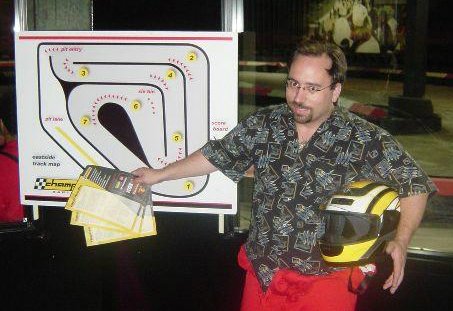
One of the things they do at Microsoft is hold morale events. Yesterday, as a kind of going-away party for our interns, eleven of us went to Champs Karting to race electric go-karts. I qualified (in third) for the final race and finished in third. Two things about this picture: (1) check out the snazzy new shirt I got from Value Village for $6, and (2) I have no idea why this picture makes me look like I dyed my hair blond, because I didn't. Thanks go to Ram for taking this picture.
Thursday, July 29, 2004
Texas Hold'Em
Last night Adam invited me and a couple other people over to his house to try out his new hobby, playing poker, or more specifically, Texas Hold'Em. Texas Hold'Em is a version of poker where you have two cards you keep to yourself and there are five community cards. You use the seven cards to make the best five card hand you can. There are four rounds of betting each hand, unless everyone but the winner folds. First, after you see your two private cards, then after the first three community cards are shown, then after the fourth, and finally after the fifth.
I was a little skeptical about how I'd enjoy it, as I've never liked the idea of gambling, so I was pleasantly surprised. We were playing with bets that were only twenty cents in size, so there was little real risk, but it was just enough to make it kind of fun. I came out of it with just under $3 in winnings, which based on twenty cent bets is something like "seven big bets" as Adam explained, although today that isn't quite adding up - I'll have to ask him again. He said that's very good, as when he and his friend Chris play, they are content with 1.5 big bets per hour. If you do that consistently, which I guess they both do, you can then count on winnings at 1.5 times the big bet per table you play on per hour.
Chris (again, Adam's friend, a male, rather than his wife, a female) has apparently played often, on three tables at once online, for stakes that are high enough that he's made some $27,000 playing poker in the last couple months, effectively more than I make at my job at Microsoft. He's now facing what is apparently a common problem for gamblers - should he just do it as his primary means of making an income, leaving his job as a university professor? If so, his new role in society is to make money by taking it directly from others. At some point, when it becomes interesting for others to watch you play, I guess you become an entertainer, which is more like acting or professional sports, but on the way up, there's little in teh way of socially redeeming aspects to the work.
I'm sure for some, this is no problem. I know I'd have a difficult time with it, although I think I could actually become pretty good at poker if I were to focus on it. One of my early professional positions, I was writing software that was used for an accounting purpose - tracking the bills and payments for the lawyers that were representing insurance companies that were involved in lawsuits with other insurance companies they had insured (called reinsurance) where the "reinsured" company had taken losses from asbestos and environmental pollution claims and wanted reimbursement. That was far away from anything I could consider socially redeeming, and even in my early twenties, it bothered me. Yet, it could perhaps be considered more socially redeeming than being a middle-tier gambler.
But back to the game aspect. In general, my problem with gambling is that I know it's something where the casino takes your money. Poker does seem different, though, as there's an element of calculating odds, deciding when to bet or fold, plus some bluffing and reading other's emotions over their hands. If you are a better player than those you play with, you will win money over time. Adam and Chris have already proved that - Chris started with something like $10, Adam with $100, and they both declared they would quit if they ever lost that starting "seed money." Neither has done that, and Chris is probably in the hundreds of thousands of dollars of winnings and Adam, who started much more recently after hearing Chris' success, was up about $500 as of last night.
So, would I play it again? You bet!
I was a little skeptical about how I'd enjoy it, as I've never liked the idea of gambling, so I was pleasantly surprised. We were playing with bets that were only twenty cents in size, so there was little real risk, but it was just enough to make it kind of fun. I came out of it with just under $3 in winnings, which based on twenty cent bets is something like "seven big bets" as Adam explained, although today that isn't quite adding up - I'll have to ask him again. He said that's very good, as when he and his friend Chris play, they are content with 1.5 big bets per hour. If you do that consistently, which I guess they both do, you can then count on winnings at 1.5 times the big bet per table you play on per hour.
Chris (again, Adam's friend, a male, rather than his wife, a female) has apparently played often, on three tables at once online, for stakes that are high enough that he's made some $27,000 playing poker in the last couple months, effectively more than I make at my job at Microsoft. He's now facing what is apparently a common problem for gamblers - should he just do it as his primary means of making an income, leaving his job as a university professor? If so, his new role in society is to make money by taking it directly from others. At some point, when it becomes interesting for others to watch you play, I guess you become an entertainer, which is more like acting or professional sports, but on the way up, there's little in teh way of socially redeeming aspects to the work.
I'm sure for some, this is no problem. I know I'd have a difficult time with it, although I think I could actually become pretty good at poker if I were to focus on it. One of my early professional positions, I was writing software that was used for an accounting purpose - tracking the bills and payments for the lawyers that were representing insurance companies that were involved in lawsuits with other insurance companies they had insured (called reinsurance) where the "reinsured" company had taken losses from asbestos and environmental pollution claims and wanted reimbursement. That was far away from anything I could consider socially redeeming, and even in my early twenties, it bothered me. Yet, it could perhaps be considered more socially redeeming than being a middle-tier gambler.
But back to the game aspect. In general, my problem with gambling is that I know it's something where the casino takes your money. Poker does seem different, though, as there's an element of calculating odds, deciding when to bet or fold, plus some bluffing and reading other's emotions over their hands. If you are a better player than those you play with, you will win money over time. Adam and Chris have already proved that - Chris started with something like $10, Adam with $100, and they both declared they would quit if they ever lost that starting "seed money." Neither has done that, and Chris is probably in the hundreds of thousands of dollars of winnings and Adam, who started much more recently after hearing Chris' success, was up about $500 as of last night.
So, would I play it again? You bet!
Monday, July 26, 2004
Space Needle Photo
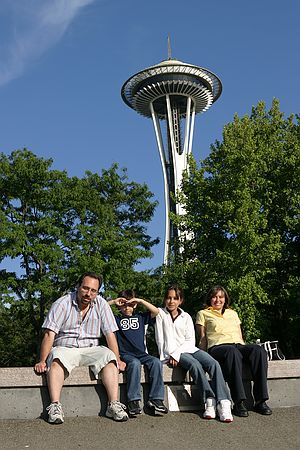
Here's another shot from the trip to Seattle Center, in front of the Space Needle. Giuseppe, Gaia, and Monica join me in basking in front of a fountain (behind Roberto, taking picture). You can see the fountain and a bunch of other pictures Roberto took yesterday over here.
Photo of Me, Blogging

While at Seattle Center, waiting for the Harry Potter movie on the IMAX screen, I took the opportunity to try blogging via my phone while Giuseppe checked it out. Roberto got a picture.
Sunday, July 25, 2004
Seattle Center
I'm waiting at the moment with Roberto and family to go to our third IMAX film of the day - Harry Potter and the Prisoner of Azkaban. Earlier, we saw Bugs 3D and Coral Reef. The goggles worn in the bugs film gave me a headache. We also visited the Science Fiction Museum, which was very cool. It's all right under the Space Needle, which I have yet to go up in.
It's been nice to see some uniquely Seattle sights, something I've done too little of since moving here. Of course, the coral reef film tells me I must visit the South Pacific. One more place to visit in a long list.
It's been nice to see some uniquely Seattle sights, something I've done too little of since moving here. Of course, the coral reef film tells me I must visit the South Pacific. One more place to visit in a long list.

Thursday, July 22, 2004
Gazzam Lake Water Towers
Trevor pointed out I'd somehow forgotten to mention the two ominous water towers, looming like guardians over the trail entrance. They were covered up to about six feet in height in mystical glyphs and images of fear, terror, and nice little park animals. One even had a painting of a leering face that welcomes you to your doom and laughs at your impending misfortune.
Olympia tells me that would be about as far as she would get, as she finds water towers incredibly scary. I wonder what she thinks of clowns?
Olympia tells me that would be about as far as she would get, as she finds water towers incredibly scary. I wonder what she thinks of clowns?
Subscribe to:
Posts (Atom)